

Variable compensation
Variable compensation philosophy
Section titled “Variable compensation philosophy”Since January 2025, Nebulab has a variable compensation component aimed at rewarding individual and company-wide performance, aligning with market benchmarks, maintaining a fair and transparent structure, and tying salaries to company performance. This component is available only if the company meets certain performance thresholds, allowing for budget flexibility: rewarding employees when the company is successful and protecting the company during financially challenging years.
Additionally, the goal is to directly incentivize employees to grow and contribute to the company’s success, fostering a sense of partnership that is common in consulting firms. This approach ties revenues and profitability to individual contributions, reinforcing the idea that employees’ growth and performance are key drivers of Nebulab’s overall success.
Common rules for variable compensation
Section titled “Common rules for variable compensation”Promotions and band adjustments don’t affect variable compensation: employees who get one still receive their Performance Bonus or Profit Sharing in the same fiscal year. Employees eligible for the Performance Bonus are excluded from the Profit Sharing Program, and vice versa, to prevent the concentration of resources on a few individuals.
Both programs depend on the company’s overall performance; if certain company performance thresholds are not met, neither program will be activated.
Another important factor in determining variable compensation is the performance score resulting from the performance review. The performance review assigns a qualitative score—Below Expectations, Meeting Expectations, or Exceeding Expectations—which is then turned into a multiplier (factor) applied to the bonus or profit-sharing target amounts.
The three performance scores are defined as follows:
- Below Expectations: no bonus will be issued.
- Meeting Expectations: the target bonus will be fully issued.
- Exceeding Expectations: the target bonus will be issued with a 20% prize.
Targets are expressed as a percentage of the total rewards and serve as the initial value, which will be adjusted by the performance score.
Variable compensation structure
Section titled “Variable compensation structure”The variable component will consist of two main programs:
Performance bonus program
Section titled “Performance bonus program”The Performance Bonus Program is available to all full-time employees under the L1 to L4 roles. The target bonus amount will be 2% of the employee’s annual total rewards amount, with the total budget being 50% of the available budget for the compensation cycle (see Budget allocation). The bonus will be awarded based on a performance matrix, where, for example, “Exceeds Expectations” receives the target bonus +20%. The target is the initial value, and the final bonus amount is adjusted based on the performance score multiplier. The distribution will be paid annually in July, the month after the performance review.
Profit sharing program
Section titled “Profit sharing program”The Profit Sharing Program is available to employees with at least two years of company tenure and falls under the L5 roles. The profit-sharing pool will have a total budget of 20% of the available budget for the compensation cycle, and the individual target will be 4% of the employee’s annual total rewards amount. Similar to the Performance Bonus Program, the payout depends on the performance score, where, for example, “Exceeds Expectations” receives the target bonus +20%, but is capped at €3,000. The target is the initial value, and the final profit-sharing amount is adjusted based on the performance score multiplier. The distribution will be paid annually in July, the month after the performance review.
Budget allocation
Section titled “Budget allocation”Budgeting for variable compensation is part of the broader compensation review budgeting process. The entire budget will be 10%-15% of the company’s profit before taxes, with a minimum threshold of 5% profit margin for band adjustments and promotions, and 10% profit margin for activating variable compensation packages.
This approach aligns compensation with the company’s financial health, ensuring flexibility to reward employees while also prioritizing promotions and band adjustments, which helps ensure fairness by reflecting an accurate market value for each role. We aim to divide the available budget by following these guidelines:
- Band adjustments: 5% - minimum 5% profit margin
- Promotion ratio: 25% - minimum 5% profit margin
- Bonus ratio: 40% - minimum 10% profit margin
- Profit sharing ratio: 30% - minimum 10% profit margin
These ratios serve as guidelines for how the total budget should be split among different purposes. The exact allocation may vary depending on the specific needs and decisions made during the salary review session.
Rebalancing factor
Section titled “Rebalancing factor”When the budget allows, the programs will be executed as originally planned. However, if the budget is not sufficient to fully fund the programs as described, a rebalancing factor will be applied. This factor is calculated as the percentage by which the program’s total exceeds the available budget. For example, if after the compensation review there are €50,000 worth of programs but only €40,000 available in the budget, the rebalancing factor is calculated as the deficit percentage: (40,000 - 50,000) / 50,000 = -20%. This means all payouts that would have been issued under a fully funded budget are reduced by 20%. The rebalancing factor ensures the company’s financial health is maintained while keeping the overall model intact, proportionally reducing only the size of the payouts.
Flowchart
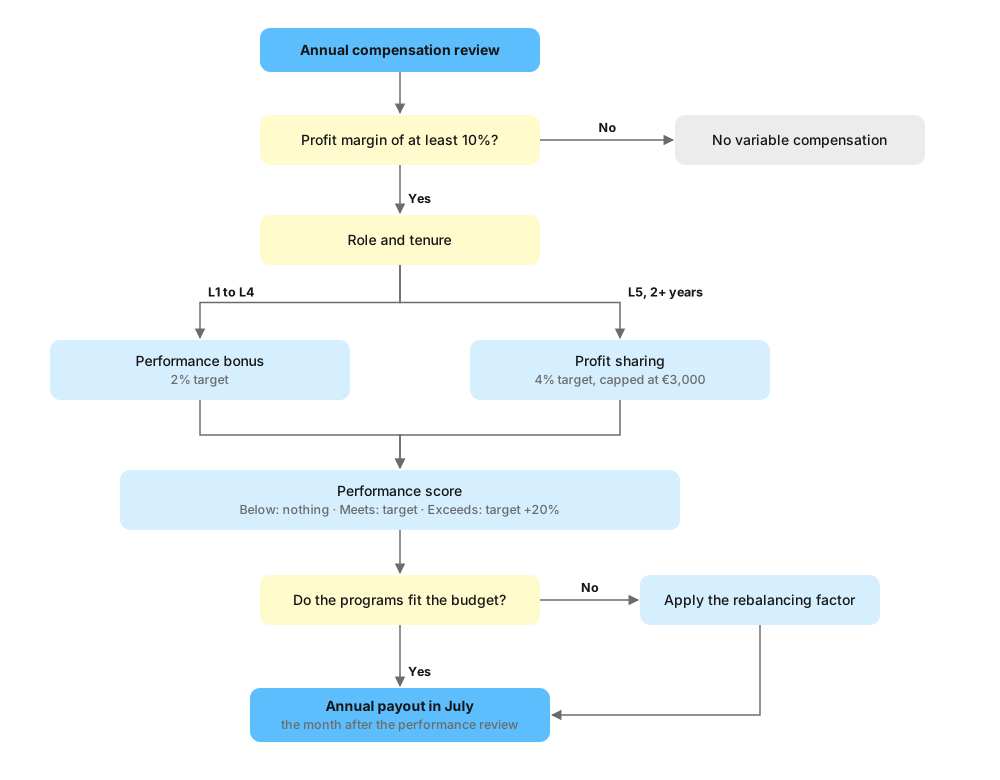
Section titled “Flowchart”The variable compensation mechanism involves complex dynamics, which can feel overwhelming initially. To make this easier to understand, the following flowchart visually represents how the variable compensation process works. It illustrates key elements such as the decision-making process, eligibility criteria, and the rebalancing mechanism.
Finding your variable compensation data
Section titled “Finding your variable compensation data”See Finding your compensation data in Compensation.